காஜா பகுதியிலிருந்து தொடர்ந்து ராக்கெட் தாக்குதலுக்கு பதிலடியாக இன்று இஸ்ரேல் திருப்பி அடித்தது.
ஹமாஸ் படையினரின் முகாம்களை குறி வைத்து தாக்கியதில் 200பேருக்கும் மேற்பட்ட ஹமாஸ் படையினர் உயிரிழந்தனர்.
Israel strikes demolish Hamas compounds, kill 192
By IBRAHIM BARZAK – 28 minutes ago
GAZA CITY, Gaza Strip (AP) — Israeli warplanes retaliating for rocket fire from the Gaza Strip pounded dozens of security compounds across the Hamas-ruled territory in unprecedented waves of airstrikes Saturday, killing nearly 200 people and wounding 270 others in the single bloodiest day of fighting in years.
Most of those killed were security men, but civilians were also among the dead. Hamas said all of its security installations were hit and responded with several medium-range Grad rockets at Israel, reaching deeper than in the past. One Israeli was killed and at least four people were wounded in the rocket attacks. With so many wounded, the Palestinian death toll was likely to rise.
The air offensive followed weeks of intense Palestinian rocket and mortar fire on southern Israel, and Israeli leaders had issued increasingly tough warnings in recent days that they would not tolerate continued attacks.
Defense Minister Ehud Barak said Israel would expand the operation if necessary. "There is a time for calm and there is a time for fighting, and now is the time for fighting," he told a news conference. He would not comment when asked if a ground offensive was planned.
But asked earlier if Hamas political leaders might be targeted next, military spokeswoman Maj. Avital Leibovich said, "Any Hamas target is a target."
The strikes caused widespread panic and confusion in Gaza, as black clouds of smoke rose above the territory, ruled by Hamas for the past 18 months. Some of the Israeli missiles struck in densely populated areas as children were leaving school, and women rushed into the streets frantically looking for their children. Most of those killed were security men, but civilians were among the dead.
Said Masri sat in the middle of a Gaza City street, close to a security compound, alternately slapping his face and covering his head with dust from the bombed-out building.
"My son is gone, my son is gone," wailed Masri, 57. The shopkeeper said he sent his 9-year-old son out to purchase cigarettes minutes before the airstrikes began and now could not find him. "May I burn like the cigarettes, may Israel burn," Masri moaned.
In Gaza City's main security compound, bodies of more than a dozen uniformed security officers lay on the ground. One survivor raised his index finger in a show of Muslim faith, uttering a prayer. The Gaza police chief was among those killed. One man, his face bloodied, sat dazed on the ground as a fire raged nearby.
Later, some of the dead, rolled in blankets, were laid out on the floor of Gaza's main hospital for identification. Hamas police spokesman Ehad Ghussein said about 140 Hamas security forces were killed.
Israeli military officials said more than 100 tons of bombs were dropped on Gaza by mid-afternoon. They spoke on condition of anonymity under military guidelines.
Defiant Hamas leaders threatened revenge, including suicide attacks. Hamas "will continue the resistance until the last drop of blood," vowed spokesman Fawzi Barhoum.
Israel told its civilians near Gaza to take cover as militants began retaliating with rockets, and in the West Bank, moderate Palestinian President Mahmoud Abbas called for restraint. Egypt summoned the Israeli ambassador to express condemnation and opened its border with Gaza to allow ambulances to drive out some of the wounded.
Israeli leaders approved military action against Gaza earlier in the week.
Past limited ground incursions and air strikes have not halted rocket barrages from Gaza. But with 200 mortars and rockets raining down on Israel since the truce expired a week ago, and 3,000 since the beginning of the year, according to the military's count, pressure had been mounting in Israel for the military to crush the gunmen.
Gaza militants fired 30 rockets and mortars Saturday after the air offensive began. A missile hit the town of Netivot, killing an Israeli man and wounding four people, rescue services said.
Dozens of stunned residents gathered around the house that took the deadly rocket hit. Many wept openly. The crowd broke up after an alert siren went off and sent the onlookers running.
Streets were nearly empty in Sderot, the Israeli border town that has been pummeled hardest by rockets. A few cars carried panicked residents leaving town. Dozens of people congregated on a hilltop to watch the Israeli aerial attacks.
Israel declared a state of emergency in Israeli communities within a 12-mile (20-kilometer) range of Gaza, putting the area on a war footing. A siren went off in Kiryat Gat, about 12 miles (20 kilometers) from the border, but early reports that the town was hit by a rocket for the first time were incorrect.
Barak, the Israeli defense minister, said the coming period "won't be easy" for southern Israel.
Protests against the campaign erupted in the Abbas-ruled West Bank and across the Arab world.
Several hundred angry Jordanians protested outside a U.N. complex in the capital Amman. "Hamas, go ahead. You are the cannon, we are the bullets," they cried, some waving the signature green Hamas banners.
In Ein Hilweh, a Palestinian refugee camp in Lebanon, dozens of youths hit the streets and set fire to tires. In Syria's al-Yarmouk camp, outside Damascus, dozens of Palestinian protesters vowed to continue fighting Israel.
The first round of air strikes on Gaza came just before noon.
Hospitals crowded with people, civilians rushing in wounded people in cars, vans and ambulances. "We are treating people on the floor, in the corridors. We have no more space. We don't know who is here or who to treat first," said one doctor who hung up the phone before identifying himself at Shifa Hospital, Gaza's main treatment center.
Dr. Moawiya Hassanain, a Gaza Health Ministry official, said at least 192 people were killed and 270 wounded. Frantic civilians drove wounded people to hospitals in their cars.
In the West Bank, Hamas' rival, Abbas, said in a statement that he "condemns this aggression" and called for restraint, according to an aide, Nabil Abu Rdeneh. Abbas, who has ruled only the West Bank since the Islamic Hamas seized power in Gaza in June 2007, was in contact with Arab leaders, and his West Bank Cabinet convened an emergency session.
Israel has targeted Gaza in the past, but the number of simultaneous attacks was unprecedented.
Israel left Gaza in 2005 after a 38-year occupation, but the withdrawal did not lead to better relations with Palestinians in the territory as Israeli officials had hoped.
Instead, the evacuation was followed by a sharp rise in militant attacks on Israeli border communities that on several occasions provoked harsh Israeli military reprisals.
The last, in late February and early March, spurred both sides to agree to a truce that was to have lasted six months but began unraveling in early November.
(This version CORRECTS that siren went off in Kiryat Gat, but there was no rocket.)
Showing posts with label இஸ்ரேல். Show all posts
Showing posts with label இஸ்ரேல். Show all posts
Saturday, December 27, 2008

Sunday, September 07, 2008
யூத மதப்புத்தகம் டோரா மீது ஒண்ணுக்கு அடித்த முஸ்லீம்கள்
யூத மதப்புத்தகம் டோரா மீது ஒண்ணுக்கு அடித்துள்ளனர் முஸ்லீம்கள் பயங்கரவாதிகள்.
Headline News
Sunday, September 07, 2008 Israel Today Staff
Muslims urinate on Torah scrolls in Hebron
Jewish worshippers returning to Hebron's Cave of the Patriarchs after Muslims were given exclusive access to the holy site at the weekend reported that the cabinet containing their Torah scrolls had been urinated on.
One Jewish resident of Hebron told Israel National News that he and several other men had to move the cabinet to another part of the room because of the strong smell of urine in the area where it is usually positioned.
Additionally, green Hamas flags were found placed in the windows that mark the burial sites of Abraham, Isaac, Sara, Rebecca and Leah.
The Cave of the Patriarchs is split into Jewish and Muslim sections, as both groups revere Abraham.
Several times a year, the holy site is given over to one or the other group exclusively to mark special holy days. Muslims were given exclusive access to the Cave of the Patriarchs on Friday to mark their holy month of Ramadan.
Another Jewish resident of Hebron said that some damage to Jewish religious articles or the Jewish side of the site is found every time the Muslims take over.
Headline News
Sunday, September 07, 2008 Israel Today Staff
Muslims urinate on Torah scrolls in Hebron
Jewish worshippers returning to Hebron's Cave of the Patriarchs after Muslims were given exclusive access to the holy site at the weekend reported that the cabinet containing their Torah scrolls had been urinated on.
One Jewish resident of Hebron told Israel National News that he and several other men had to move the cabinet to another part of the room because of the strong smell of urine in the area where it is usually positioned.
Additionally, green Hamas flags were found placed in the windows that mark the burial sites of Abraham, Isaac, Sara, Rebecca and Leah.
The Cave of the Patriarchs is split into Jewish and Muslim sections, as both groups revere Abraham.
Several times a year, the holy site is given over to one or the other group exclusively to mark special holy days. Muslims were given exclusive access to the Cave of the Patriarchs on Friday to mark their holy month of Ramadan.
Another Jewish resident of Hebron said that some damage to Jewish religious articles or the Jewish side of the site is found every time the Muslims take over.
Tuesday, August 19, 2008
இஸ்ரேல். இடிந்த சர்ச்சின் கீழ் புராதன கோவில் கண்டுபிடிப்பு
புராதன கோவிலை இடித்து அதன் மீது சர்ச் கட்டப்பட்டிருப்பது கண்டுபிடிக்கப்பட்டுள்ளது.
Ancient Pagan Temple Found in Israel
Mati Milstein in Zippori National Park, Israel
for National Geographic News
August 15, 2008

Ruins of a pagan temple from the second century A.D. have been unearthed in the heart of a Jewish capital that existed during Israel's Roman period.
In its heyday, the temple sat within a walled courtyard abutting the most centrally-located homes in the ancient city of Zippori, about halfway between Lake Kinneret (Sea of Galilee) and the Mediterranean.
PHOTO: Pagans Honor Zeus at Ancient Athens Temple (January 22, 2007)
Ancient Olympics Mixed Naked Sports, Pagan Partying (August 13, 2004)
Israel: Fast Facts, Photos, Music, More
Archaeologists discovered the temple's foundations under the ruins of a Christian church that had been built on the site during the Byzantine period, which spanned the fifth and sixth centuries.
Although pagan artifacts have been found in Zippori before, the temple represents the first significant structural evidence of a pagan settlement in the capital.
"We have textual accounts from the second century indicating the presence of a pagan population in Zippori," said Zeev Weiss, lead archaeologist of the Noam Shudofsky Zippori Expedition at the Hebrew University of Jerusalem.
Based on the new find, "it is clear [the pagans] had the influence and the ability to erect this temple in the center of the city."
Zippori was a thriving multicultural center where tens of thousands of pagans, Jews, and Christians lived and worshipped, the researchers say.
(Related: "Catacomb Find Boosts Early Christian-Jewish Ties, Study Says" [July 20, 2005].)
Temple of the Gods
The newfound temple measures about 40-by-78 feet (12-by-24 meters). It was built just south of the decumanus, a colonnaded street running east to west that served as the main thoroughfare in most Roman cities.
The temple originally had a decorated façade, but its walls were plundered in ancient times and only the foundations have survived.
No archaeological evidence was found to indicate the nature of pagan rituals carried out in the temple. The structure was not built like a Jewish synagogue, and formal Christian churches did not exist until at least the third century A.D.
Ancient Pagan Temple Found in Israel
Mati Milstein in Zippori National Park, Israel
for National Geographic News
August 15, 2008
Ruins of a pagan temple from the second century A.D. have been unearthed in the heart of a Jewish capital that existed during Israel's Roman period.
In its heyday, the temple sat within a walled courtyard abutting the most centrally-located homes in the ancient city of Zippori, about halfway between Lake Kinneret (Sea of Galilee) and the Mediterranean.
PHOTO: Pagans Honor Zeus at Ancient Athens Temple (January 22, 2007)
Ancient Olympics Mixed Naked Sports, Pagan Partying (August 13, 2004)
Israel: Fast Facts, Photos, Music, More
Archaeologists discovered the temple's foundations under the ruins of a Christian church that had been built on the site during the Byzantine period, which spanned the fifth and sixth centuries.
Although pagan artifacts have been found in Zippori before, the temple represents the first significant structural evidence of a pagan settlement in the capital.
"We have textual accounts from the second century indicating the presence of a pagan population in Zippori," said Zeev Weiss, lead archaeologist of the Noam Shudofsky Zippori Expedition at the Hebrew University of Jerusalem.
Based on the new find, "it is clear [the pagans] had the influence and the ability to erect this temple in the center of the city."
Zippori was a thriving multicultural center where tens of thousands of pagans, Jews, and Christians lived and worshipped, the researchers say.
(Related: "Catacomb Find Boosts Early Christian-Jewish Ties, Study Says" [July 20, 2005].)
Temple of the Gods
The newfound temple measures about 40-by-78 feet (12-by-24 meters). It was built just south of the decumanus, a colonnaded street running east to west that served as the main thoroughfare in most Roman cities.
The temple originally had a decorated façade, but its walls were plundered in ancient times and only the foundations have survived.
No archaeological evidence was found to indicate the nature of pagan rituals carried out in the temple. The structure was not built like a Jewish synagogue, and formal Christian churches did not exist until at least the third century A.D.
Wednesday, November 21, 2007
பாலஸ்தீன படைகளுக்கு இஸ்ரேல் ராணுவ உதவி
இஸ்ரேல், பால்ஸ்தீன அரசுக்கு ஆயிரக்கணக்கான துப்பாக்கிகளும், ரவைகளும், கவச வண்டிகளையும் வழங்கியுள்ளது.
Israel OKs Armored Vehicles for Abbas
Wednesday November 21, 2007 2:46 PM
By LAURIE COPANS
Associated Press Writer
JERUSALEM (AP) - Israel said Wednesday it has approved a Russian shipment of armored vehicles and guns to help Palestinian President Mahmoud Abbas in his fight against militants in the West Bank ahead of next week's Mideast conference.
In another conciliatory gesture, Israel will allow resumption of strawberry and flower exports from the Gaza Strip in the hopes of improving the economic situation for the 1.5 million Palestinians living there, Israeli Agriculture Minister Shalom Simchon said Wednesday.
Since the Hamas militant group took control of Gaza last June, Israel has blocked almost all exports from the area.
Israel and the Palestinians on Tuesday received long-awaited invitations to the U.S. conference, where they are expected to relaunch formal negotiations on a final peace agreement for the first time in seven years. Prime Minister Ehud Olmert said Tuesday that a peace deal with the Palestinians was possible as early as next year.
Israel's decision to allow the Russian shipment of armored vehicles - along with 1,000 rifles and 2 million rounds of ammunition - came despite opposition from Israel's army and the country's internal Shin Bet security service.
Security officials said they fear the vehicles and weapons will fall into the hands of Hamas. The officials spoke on condition of anonymity because of security concerns.
A Hamas spokesman, Sami Au Zuhri, said the Israeli decision proved Abbas was working ``hand in hand with the occupation against (Palestinian) resistance.''
``Hamas will remain committed to fight against the occupation and will not give up,'' Abu Zuhri said.
During its takeover of Gaza, the Islamic group expelled Fatah forces loyal to Abbas and captured large quantities of weapons supplied to Fatah by the United States and others with Israeli approval.
Since losing Gaza, Abbas and Fatah have been locked in a so-far quiet struggle with Hamas over control of the West Bank. Israel still has large numbers of troops in the West Bank that back Fatah, giving Abbas the upper hand. Israel withdrew from Gaza in 2005.
Russia proposed shipping the armored vehicles to Palestinian security forces two years ago, but the deal was stalled because of Israeli opposition. No timeframe was given for arrival of the vehicles or munitions.
The leader of the opposition Likud Party, Benjamin Netanyahu, objected to the deal, saying Abbas was not strong enough to receive weapons. ``We will one day see Hamas sitting on the armored vehicles, firing at us,'' Netanyahu told Army Radio.
The Hamas takeover led to an Israeli ban on exports from Gaza, which the area's 40,000 farmers have repeatedly demanded be lifted. Simchon's announcement that flower and strawberry shipments will resume will bring in at least $14 million for farmers, the Palestinian Chamber of Commerce said.
Israel also has halted imports to Gaza, except for food and humanitarian goods. Simchon said Israel will further ease trade with the area soon.
The Israeli decisions were meant to improve trust ahead of next week's conference in Annapolis, Md.
U.S. consul Jacob Walles said Abbas received his invitation during a meeting Tuesday. Olmert's office later said Israel also had been invited.
After a meeting with Egyptian President Hosni Mubarak on Tuesday in the Egyptian resort of Sharm el-Sheik, Olmert pledged to follow the peace conference with serious negotiations on all outstanding issues.
The U.S. has been pushing the sides to endorse a joint document laying out their vision for peace ahead of the conference.
Negotiators say they have made little progress, casting a cloud over the summit. But Olmert on Tuesday offered an optimistic view of peace prospects with the Palestinians.
``I very much hope we can reach this agreement in the course of 2008,'' Olmert said in a news conference with Mubarak. However, Olmert also signaled that carrying out any peace deal would have to wait until Abbas regains control of the Gaza Strip from Hamas.
Olmert's one-day trip to Egypt came ahead of a meeting in Cairo Friday of the Arab League, where Arab governments will decide whether to attend the conference.
Arab participation is considered critical for the summit's success, and the states have been reluctant to commit over concern Israel is not serious about addressing the core issues of its conflict with the Palestinians.
Israel OKs Armored Vehicles for Abbas
Wednesday November 21, 2007 2:46 PM
By LAURIE COPANS
Associated Press Writer
JERUSALEM (AP) - Israel said Wednesday it has approved a Russian shipment of armored vehicles and guns to help Palestinian President Mahmoud Abbas in his fight against militants in the West Bank ahead of next week's Mideast conference.
In another conciliatory gesture, Israel will allow resumption of strawberry and flower exports from the Gaza Strip in the hopes of improving the economic situation for the 1.5 million Palestinians living there, Israeli Agriculture Minister Shalom Simchon said Wednesday.
Since the Hamas militant group took control of Gaza last June, Israel has blocked almost all exports from the area.
Israel and the Palestinians on Tuesday received long-awaited invitations to the U.S. conference, where they are expected to relaunch formal negotiations on a final peace agreement for the first time in seven years. Prime Minister Ehud Olmert said Tuesday that a peace deal with the Palestinians was possible as early as next year.
Israel's decision to allow the Russian shipment of armored vehicles - along with 1,000 rifles and 2 million rounds of ammunition - came despite opposition from Israel's army and the country's internal Shin Bet security service.
Security officials said they fear the vehicles and weapons will fall into the hands of Hamas. The officials spoke on condition of anonymity because of security concerns.
A Hamas spokesman, Sami Au Zuhri, said the Israeli decision proved Abbas was working ``hand in hand with the occupation against (Palestinian) resistance.''
``Hamas will remain committed to fight against the occupation and will not give up,'' Abu Zuhri said.
During its takeover of Gaza, the Islamic group expelled Fatah forces loyal to Abbas and captured large quantities of weapons supplied to Fatah by the United States and others with Israeli approval.
Since losing Gaza, Abbas and Fatah have been locked in a so-far quiet struggle with Hamas over control of the West Bank. Israel still has large numbers of troops in the West Bank that back Fatah, giving Abbas the upper hand. Israel withdrew from Gaza in 2005.
Russia proposed shipping the armored vehicles to Palestinian security forces two years ago, but the deal was stalled because of Israeli opposition. No timeframe was given for arrival of the vehicles or munitions.
The leader of the opposition Likud Party, Benjamin Netanyahu, objected to the deal, saying Abbas was not strong enough to receive weapons. ``We will one day see Hamas sitting on the armored vehicles, firing at us,'' Netanyahu told Army Radio.
The Hamas takeover led to an Israeli ban on exports from Gaza, which the area's 40,000 farmers have repeatedly demanded be lifted. Simchon's announcement that flower and strawberry shipments will resume will bring in at least $14 million for farmers, the Palestinian Chamber of Commerce said.
Israel also has halted imports to Gaza, except for food and humanitarian goods. Simchon said Israel will further ease trade with the area soon.
The Israeli decisions were meant to improve trust ahead of next week's conference in Annapolis, Md.
U.S. consul Jacob Walles said Abbas received his invitation during a meeting Tuesday. Olmert's office later said Israel also had been invited.
After a meeting with Egyptian President Hosni Mubarak on Tuesday in the Egyptian resort of Sharm el-Sheik, Olmert pledged to follow the peace conference with serious negotiations on all outstanding issues.
The U.S. has been pushing the sides to endorse a joint document laying out their vision for peace ahead of the conference.
Negotiators say they have made little progress, casting a cloud over the summit. But Olmert on Tuesday offered an optimistic view of peace prospects with the Palestinians.
``I very much hope we can reach this agreement in the course of 2008,'' Olmert said in a news conference with Mubarak. However, Olmert also signaled that carrying out any peace deal would have to wait until Abbas regains control of the Gaza Strip from Hamas.
Olmert's one-day trip to Egypt came ahead of a meeting in Cairo Friday of the Arab League, where Arab governments will decide whether to attend the conference.
Arab participation is considered critical for the summit's success, and the states have been reluctant to commit over concern Israel is not serious about addressing the core issues of its conflict with the Palestinians.
Sunday, September 16, 2007
சிரியாவின் அணு ஆயுத ஆலையை இஸ்ரேல் தகர்ப்பு
வட கொரியா சிரியாவுக்கு கொடுத்திருந்த அணு ஆயுத உலை, ரகசிய கிடங்கு ஆகியவற்றை இஸ்ரேல் விமானங்கள் குண்டு வீசி தகர்த்தன.
இஸ்ரேல் விமானங்கள் எல்லை தாண்டி சிரியாவுக்குள் 50 மைல்கள் சென்று அங்கு விவசாய ஆலை என்ற போர்வையில் நடந்துகொண்டிருந்த அணு ஆயுத உலையை குண்டுகள் வீசி தகர்த்தன.
திருடனுக்கு தேள் கொட்டியது போல சிரியா இதனை பற்றி பேச மறுக்கிறது. அதிகாரபூர்வமாக வெளியிட்ட செய்தியில், ஹிஸ்பொல்லாவுக்கு அனுப்ப இருந்த ஆயுதங்கள் மீது இஸ்ரேல் குண்டு வீசியிருக்கிறது என்பதை ஒப்புக்கொண்டுள்ளனர்.
Israelis ‘blew apart Syrian nuclear cache’
Secret raid on Korean shipment
Uzi Mahnaimi in Tel Aviv, Sarah Baxter in Washington and Michael Sheridan
IT was just after midnight when the 69th Squadron of Israeli F15Is crossed the Syrian coast-line. On the ground, Syria’s formidable air defences went dead. An audacious raid on a Syrian target 50 miles from the Iraqi border was under way.
At a rendezvous point on the ground, a Shaldag air force commando team was waiting to direct their laser beams at the target for the approaching jets. The team had arrived a day earlier, taking up position near a large underground depot. Soon the bunkers were in flames.
Ten days after the jets reached home, their mission was the focus of intense speculation this weekend amid claims that Israel believed it had destroyed a cache of nuclear materials from North Korea.
The Israeli government was not saying. “The security sources and IDF [Israeli Defence Forces] soldiers are demonstrating unusual courage,” said Ehud Olmert, the prime minister. “We naturally cannot always show the public our cards.”
Related Links
A tale of two dictatorships: The links between North Korea and Syria
The Syrians were also keeping mum. “I cannot reveal the details,” said Farouk al-Sharaa, the vice-president. “All I can say is the military and political echelon is looking into a series of responses as we speak. Results are forthcoming.” The official story that the target comprised weapons destined for Hezbollah, the Iranian-backed Lebanese Shi’ite group, appeared to be crumbling in the face of widespread scepticism.
Andrew Semmel, a senior US State Department official, said Syria might have obtained nuclear equipment from “secret suppliers”, and added that there were a “number of foreign technicians” in the country.
Asked if they could be North Korean, he replied: “There are North Korean people there. There’s no question about that.” He said a network run by AQ Khan, the disgraced creator of Pakistan’s nuclear weapons, could be involved.
But why would nuclear material be in Syria? Known to have chemical weapons, was it seeking to bolster its arsenal with something even more deadly?
Alternatively, could it be hiding equipment for North Korea, enabling Kim Jong-il to pretend to be giving up his nuclear programme in exchange for economic aid? Or was the material bound for Iran, as some authorities in America suggest?
According to Israeli sources, preparations for the attack had been going on since late spring, when Meir Dagan, the head of Mossad, presented Olmert with evidence that Syria was seeking to buy a nuclear device from North Korea.
The Israeli spy chief apparently feared such a device could eventually be installed on North-Korean-made Scud-C missiles.
“This was supposed to be a devastating Syrian surprise for Israel,” said an Israeli source. “We’ve known for a long time that Syria has deadly chemical warheads on its Scuds, but Israel can’t live with a nuclear warhead.”
An expert on the Middle East, who has spoken to Israeli participants in the raid, told yesterday’s Washington Post that the timing of the raid on September 6 appeared to be linked to the arrival three days earlier of a ship carrying North Korean material labelled as cement but suspected of concealing nuclear equipment.
The target was identified as a northern Syrian facility that purported to be an agricultural research centre on the Euphrates river. Israel had been monitoring it for some time, concerned that it was being used to extract uranium from phosphates.
According to an Israeli air force source, the Israeli satellite Ofek 7, launched in June, was diverted from Iran to Syria. It sent out high-quality images of a northeastern area every 90 minutes, making it easy for air force specialists to spot the facility.
Early in the summer Ehud Barak, the defence minister, had given the order to double Israeli forces on its Golan Heights border with Syria in anticipation of possible retaliation by Damascus in the event of air strikes.
Sergei Kirpichenko, the Russian ambassador to Syria, warned President Bashar al-Assad last month that Israel was planning an attack, but suggested the target was the Golan Heights.
Israeli military intelligence sources claim Syrian special forces moved towards the Israeli outpost of Mount Hermon on the Golan Heights. Tension rose, but nobody knew why.
At this point, Barak feared events could spiral out of control. The decision was taken to reduce the number of Israeli troops on the Golan Heights and tell Damascus the tension was over. Syria relaxed its guard shortly before the Israeli Defence Forces struck.
Only three Israeli cabinet ministers are said to have been in the know � Olmert, Barak and Tzipi Livni, the foreign minister. America was also consulted. According to Israeli sources, American air force codes were given to the Israeli air force attaché in Washington to ensure Israel’s F15Is would not mistakenly attack their US counterparts.
Once the mission was under way, Israel imposed draconian military censorship and no news of the operation emerged until Syria complained that Israeli aircraft had violated its airspace. Syria claimed its air defences had engaged the planes, forcing them to drop fuel tanks to lighten their loads as they fled.
But intelligence sources suggested it was a highly successful Israeli raid on nuclear material supplied by North Korea.
Washington was rife with speculation last week about the precise nature of the operation. One source said the air strikes were a diversion for a daring Israeli commando raid, in which nuclear materials were intercepted en route to Iran and hauled to Israel. Others claimed they were destroyed in the attack.
There is no doubt, however, that North Korea is accused of nuclear cooperation with Syria, helped by AQ Khan’s network. John Bolton, who was undersecretary for arms control at the State Department, told the United Nations in 2004 the Pakistani nuclear scientist had “several other” customers besides Iran, Libya and North Korea.
Some of his evidence came from the CIA, which had reported to Congress that it viewed “Syrian nuclear intentions with growing concern”.
“I’ve been worried for some time about North Korea and Iran outsourcing their nuclear programmes,” Bolton said last week. Syria, he added, was a member of a “junior axis of evil”, with a well-established ambition to develop weapons of mass destruction.
The links between Syria and North Korea date back to the rule of Kim Il-sung and President Hafez al-Assad in the last century. In recent months, their sons have quietly ordered an increase in military and technical cooperation.
Foreign diplomats who follow North Korean affairs are taking note. There were reports of Syrian passengers on flights from Beijing to Pyongyang and sightings of Middle Eastern businessmen from sources who watch the trains from North Korea to China.
On August 14, Rim Kyong Man, the North Korean foreign trade minister, was in Syria to sign a protocol on “cooperation in trade and science and technology”. No details were released, but it caught Israel’s attention.
Syria possesses between 60 and 120 Scud-C missiles, which it has bought from North Korea over the past 15 years. Diplomats believe North Korean engineers have been working on extending their 300-mile range. It means they can be used in the deserts of northeastern Syria � the area of the Israeli strike.
The triangular relationship between North Korea, Syria and Iran continues to perplex intelligence analysts. Syria served as a conduit for the transport to Iran of an estimated £50m of missile components and technology sent by sea from North Korea. The same route may be in use for nuclear equipment.
But North Korea is at a sensitive stage of negotiations to end its nuclear programme in exchange for security guarantees and aid, leading some diplomats to cast doubt on the likelihood that Kim would cross America’s “red line” forbidding the proliferation of nuclear materials.
Christopher Hill, the State Department official representing America in the talks, said on Friday he could not confirm “intelligence-type things”, but the reports underscored the need “to make sure the North Koreans get out of the nuclear business”.
By its actions, Israel showed it is not interested in waiting for diplomacy to work where nuclear weapons are at stake.
As a bonus, the Israelis proved they could penetrate the Syrian air defence system, which is stronger than the one protecting Iranian nuclear sites.
This weekend President Mahmoud Ahmadinejad of Iran sent Ali Akbar Mehrabian, his nephew, to Syria to assess the damage. The new “axis of evil” may have lost one of its spokes.
இஸ்ரேல் விமானங்கள் எல்லை தாண்டி சிரியாவுக்குள் 50 மைல்கள் சென்று அங்கு விவசாய ஆலை என்ற போர்வையில் நடந்துகொண்டிருந்த அணு ஆயுத உலையை குண்டுகள் வீசி தகர்த்தன.
திருடனுக்கு தேள் கொட்டியது போல சிரியா இதனை பற்றி பேச மறுக்கிறது. அதிகாரபூர்வமாக வெளியிட்ட செய்தியில், ஹிஸ்பொல்லாவுக்கு அனுப்ப இருந்த ஆயுதங்கள் மீது இஸ்ரேல் குண்டு வீசியிருக்கிறது என்பதை ஒப்புக்கொண்டுள்ளனர்.
Israelis ‘blew apart Syrian nuclear cache’
Secret raid on Korean shipment
Uzi Mahnaimi in Tel Aviv, Sarah Baxter in Washington and Michael Sheridan
IT was just after midnight when the 69th Squadron of Israeli F15Is crossed the Syrian coast-line. On the ground, Syria’s formidable air defences went dead. An audacious raid on a Syrian target 50 miles from the Iraqi border was under way.
At a rendezvous point on the ground, a Shaldag air force commando team was waiting to direct their laser beams at the target for the approaching jets. The team had arrived a day earlier, taking up position near a large underground depot. Soon the bunkers were in flames.
Ten days after the jets reached home, their mission was the focus of intense speculation this weekend amid claims that Israel believed it had destroyed a cache of nuclear materials from North Korea.
The Israeli government was not saying. “The security sources and IDF [Israeli Defence Forces] soldiers are demonstrating unusual courage,” said Ehud Olmert, the prime minister. “We naturally cannot always show the public our cards.”
Related Links
A tale of two dictatorships: The links between North Korea and Syria
The Syrians were also keeping mum. “I cannot reveal the details,” said Farouk al-Sharaa, the vice-president. “All I can say is the military and political echelon is looking into a series of responses as we speak. Results are forthcoming.” The official story that the target comprised weapons destined for Hezbollah, the Iranian-backed Lebanese Shi’ite group, appeared to be crumbling in the face of widespread scepticism.
Andrew Semmel, a senior US State Department official, said Syria might have obtained nuclear equipment from “secret suppliers”, and added that there were a “number of foreign technicians” in the country.
Asked if they could be North Korean, he replied: “There are North Korean people there. There’s no question about that.” He said a network run by AQ Khan, the disgraced creator of Pakistan’s nuclear weapons, could be involved.
But why would nuclear material be in Syria? Known to have chemical weapons, was it seeking to bolster its arsenal with something even more deadly?
Alternatively, could it be hiding equipment for North Korea, enabling Kim Jong-il to pretend to be giving up his nuclear programme in exchange for economic aid? Or was the material bound for Iran, as some authorities in America suggest?
According to Israeli sources, preparations for the attack had been going on since late spring, when Meir Dagan, the head of Mossad, presented Olmert with evidence that Syria was seeking to buy a nuclear device from North Korea.
The Israeli spy chief apparently feared such a device could eventually be installed on North-Korean-made Scud-C missiles.
“This was supposed to be a devastating Syrian surprise for Israel,” said an Israeli source. “We’ve known for a long time that Syria has deadly chemical warheads on its Scuds, but Israel can’t live with a nuclear warhead.”
An expert on the Middle East, who has spoken to Israeli participants in the raid, told yesterday’s Washington Post that the timing of the raid on September 6 appeared to be linked to the arrival three days earlier of a ship carrying North Korean material labelled as cement but suspected of concealing nuclear equipment.
The target was identified as a northern Syrian facility that purported to be an agricultural research centre on the Euphrates river. Israel had been monitoring it for some time, concerned that it was being used to extract uranium from phosphates.
According to an Israeli air force source, the Israeli satellite Ofek 7, launched in June, was diverted from Iran to Syria. It sent out high-quality images of a northeastern area every 90 minutes, making it easy for air force specialists to spot the facility.
Early in the summer Ehud Barak, the defence minister, had given the order to double Israeli forces on its Golan Heights border with Syria in anticipation of possible retaliation by Damascus in the event of air strikes.
Sergei Kirpichenko, the Russian ambassador to Syria, warned President Bashar al-Assad last month that Israel was planning an attack, but suggested the target was the Golan Heights.
Israeli military intelligence sources claim Syrian special forces moved towards the Israeli outpost of Mount Hermon on the Golan Heights. Tension rose, but nobody knew why.
At this point, Barak feared events could spiral out of control. The decision was taken to reduce the number of Israeli troops on the Golan Heights and tell Damascus the tension was over. Syria relaxed its guard shortly before the Israeli Defence Forces struck.
Only three Israeli cabinet ministers are said to have been in the know � Olmert, Barak and Tzipi Livni, the foreign minister. America was also consulted. According to Israeli sources, American air force codes were given to the Israeli air force attaché in Washington to ensure Israel’s F15Is would not mistakenly attack their US counterparts.
Once the mission was under way, Israel imposed draconian military censorship and no news of the operation emerged until Syria complained that Israeli aircraft had violated its airspace. Syria claimed its air defences had engaged the planes, forcing them to drop fuel tanks to lighten their loads as they fled.
But intelligence sources suggested it was a highly successful Israeli raid on nuclear material supplied by North Korea.
Washington was rife with speculation last week about the precise nature of the operation. One source said the air strikes were a diversion for a daring Israeli commando raid, in which nuclear materials were intercepted en route to Iran and hauled to Israel. Others claimed they were destroyed in the attack.
There is no doubt, however, that North Korea is accused of nuclear cooperation with Syria, helped by AQ Khan’s network. John Bolton, who was undersecretary for arms control at the State Department, told the United Nations in 2004 the Pakistani nuclear scientist had “several other” customers besides Iran, Libya and North Korea.
Some of his evidence came from the CIA, which had reported to Congress that it viewed “Syrian nuclear intentions with growing concern”.
“I’ve been worried for some time about North Korea and Iran outsourcing their nuclear programmes,” Bolton said last week. Syria, he added, was a member of a “junior axis of evil”, with a well-established ambition to develop weapons of mass destruction.
The links between Syria and North Korea date back to the rule of Kim Il-sung and President Hafez al-Assad in the last century. In recent months, their sons have quietly ordered an increase in military and technical cooperation.
Foreign diplomats who follow North Korean affairs are taking note. There were reports of Syrian passengers on flights from Beijing to Pyongyang and sightings of Middle Eastern businessmen from sources who watch the trains from North Korea to China.
On August 14, Rim Kyong Man, the North Korean foreign trade minister, was in Syria to sign a protocol on “cooperation in trade and science and technology”. No details were released, but it caught Israel’s attention.
Syria possesses between 60 and 120 Scud-C missiles, which it has bought from North Korea over the past 15 years. Diplomats believe North Korean engineers have been working on extending their 300-mile range. It means they can be used in the deserts of northeastern Syria � the area of the Israeli strike.
The triangular relationship between North Korea, Syria and Iran continues to perplex intelligence analysts. Syria served as a conduit for the transport to Iran of an estimated £50m of missile components and technology sent by sea from North Korea. The same route may be in use for nuclear equipment.
But North Korea is at a sensitive stage of negotiations to end its nuclear programme in exchange for security guarantees and aid, leading some diplomats to cast doubt on the likelihood that Kim would cross America’s “red line” forbidding the proliferation of nuclear materials.
Christopher Hill, the State Department official representing America in the talks, said on Friday he could not confirm “intelligence-type things”, but the reports underscored the need “to make sure the North Koreans get out of the nuclear business”.
By its actions, Israel showed it is not interested in waiting for diplomacy to work where nuclear weapons are at stake.
As a bonus, the Israelis proved they could penetrate the Syrian air defence system, which is stronger than the one protecting Iranian nuclear sites.
This weekend President Mahmoud Ahmadinejad of Iran sent Ali Akbar Mehrabian, his nephew, to Syria to assess the damage. The new “axis of evil” may have lost one of its spokes.
Thursday, August 16, 2007
இந்திய இமாம்களின் தலைவர் இல்யாஸி இஸ்ரேலுக்கு சமாதான பயணம்
ஹஜ்ரத் மௌலானா ஜமீல் அஹ்மது இல்யாஸி (president of All India Association of Imams and Mosques) உலகத்தில் வாழும் முஸ்லீம்களில் 40 சதவீத முஸ்லீகள் வாழும் இந்திய துணைக்கண்டத்தில் உள்ள முஸ்லீம்கள் சார்பாக இஸ்ரேலுக்கு சமாதான பயணமாக செல்கிறார்.
இந்த பயணத்தின் நோக்கம் யூதர்கள் வாழும் இஸ்ரேலுக்கும் இந்திய முஸ்லீம்களுக்கும் நல்லுறவை ஏற்படுத்திக்கொள்வதாகும்.
ஒரு சில தீவிரவாத இஸ்லாமிய பக்கங்களிலிருந்து எதிர்ப்பு வந்தாலும் இந்திய -இஸ்ரேல் நல்லுறவுக்காக இந்த பயணத்தை மேற்கொண்டிருப்பதாக இவர் தெரிவித்துள்ளார்.
வாழ்க வளமுடன்.
India's leading imam to visit Israel
By HAVIV RETTIG
Hazrat Maulana Jameel Ahmed Ilyasi, president of the All-India Association of Imams and Mosques, will arrive in Israel on Saturday as part of a "peace delegation" of Indian Muslim leaders.
"Our visit to Israel will be historical in terms of developing a dialogue between Judaism and Islam in the Indian subcontinent, where more than 40 percent of the world Muslim population lives," Ilyasi said in a statement ahead of the visit.
Ilyasi is the leader of some 500,000 imams serving an estimated 200 million Indian Muslims.
"We are coming with the message of peace and goodwill from Indian Muslims who believe in the Indian tradition of resolving issues through dialogue and peaceful means," Ilyasi's statement continued. "Interaction with both Palestinian and Jewish sisters and brothers and their religious leadership will lay a solid foundation for future engagement."
A guest of the American Jewish Committee and the Australia Israel Jewish Affairs Council, Ilyasi and his delegation come despite angry protests in some Muslim Indian media outlets.
While most of the delegation will arrive on Wednesday, Ilyasi himself has delayed his arrival until Saturday in order to personally face the planned Friday mosque protests against his visit, the AJC said.
The delegation will spend six days in Israel and is slated to meet with President Shimon Peres, Foreign Minister Tzipi Livni and the two chief rabbis.
The visit follows a trip to India earlier in the year by a group of rabbis, including Chief Rabbi Yona Metzger and the AJC's David Rosen, which concluded with a call for religious leaders "to condemn killings, reject extremism and the misuse of religion for acts of violence. Suicide is a forbidden act in Islam, and therefore suicidal attacks cannot find sanction."
"Members of this delegation have direct influence on a wide cross-section of some 200 million Muslims all over India," Rosen explained ahead of the current visit. "The fact that the delegation is raising so much criticism in India must encourage the moderates to express their message."
Furthermore, he said, "we have developed an interreligious dialogue with the major Hindu leadership in India, and this relationship with the Indian Muslim leadership is no less important for bilateral [Israel-India] relations."
According to Rosen, Ilyasi's influence in Indian Islam is significant. "Indian Muslims are much more chaotic [than Jewish institutions]," he explained. "Islam has no formal hierarchy and therefore no binding structure. But even so, [Ilyasi] is head of over half a million imams, and he's important to all the elements within that movement. You can't say there's anybody above him."
இந்த பயணத்தின் நோக்கம் யூதர்கள் வாழும் இஸ்ரேலுக்கும் இந்திய முஸ்லீம்களுக்கும் நல்லுறவை ஏற்படுத்திக்கொள்வதாகும்.
ஒரு சில தீவிரவாத இஸ்லாமிய பக்கங்களிலிருந்து எதிர்ப்பு வந்தாலும் இந்திய -இஸ்ரேல் நல்லுறவுக்காக இந்த பயணத்தை மேற்கொண்டிருப்பதாக இவர் தெரிவித்துள்ளார்.
வாழ்க வளமுடன்.
India's leading imam to visit Israel
By HAVIV RETTIG
Hazrat Maulana Jameel Ahmed Ilyasi, president of the All-India Association of Imams and Mosques, will arrive in Israel on Saturday as part of a "peace delegation" of Indian Muslim leaders.
"Our visit to Israel will be historical in terms of developing a dialogue between Judaism and Islam in the Indian subcontinent, where more than 40 percent of the world Muslim population lives," Ilyasi said in a statement ahead of the visit.
Ilyasi is the leader of some 500,000 imams serving an estimated 200 million Indian Muslims.
"We are coming with the message of peace and goodwill from Indian Muslims who believe in the Indian tradition of resolving issues through dialogue and peaceful means," Ilyasi's statement continued. "Interaction with both Palestinian and Jewish sisters and brothers and their religious leadership will lay a solid foundation for future engagement."
A guest of the American Jewish Committee and the Australia Israel Jewish Affairs Council, Ilyasi and his delegation come despite angry protests in some Muslim Indian media outlets.
While most of the delegation will arrive on Wednesday, Ilyasi himself has delayed his arrival until Saturday in order to personally face the planned Friday mosque protests against his visit, the AJC said.
The delegation will spend six days in Israel and is slated to meet with President Shimon Peres, Foreign Minister Tzipi Livni and the two chief rabbis.
The visit follows a trip to India earlier in the year by a group of rabbis, including Chief Rabbi Yona Metzger and the AJC's David Rosen, which concluded with a call for religious leaders "to condemn killings, reject extremism and the misuse of religion for acts of violence. Suicide is a forbidden act in Islam, and therefore suicidal attacks cannot find sanction."
"Members of this delegation have direct influence on a wide cross-section of some 200 million Muslims all over India," Rosen explained ahead of the current visit. "The fact that the delegation is raising so much criticism in India must encourage the moderates to express their message."
Furthermore, he said, "we have developed an interreligious dialogue with the major Hindu leadership in India, and this relationship with the Indian Muslim leadership is no less important for bilateral [Israel-India] relations."
According to Rosen, Ilyasi's influence in Indian Islam is significant. "Indian Muslims are much more chaotic [than Jewish institutions]," he explained. "Islam has no formal hierarchy and therefore no binding structure. But even so, [Ilyasi] is head of over half a million imams, and he's important to all the elements within that movement. You can't say there's anybody above him."
Wednesday, July 18, 2007
மத்திய கிழக்கில் என்னதான் பிரச்னை?
பார்க்கவேண்டிய ஒரு பிரசண்டேஷன்
கிளிக் செய்தபின் , லோட் ஆவதற்கு சற்று காத்திருக்கவும்
http://www.terrorismawareness.org/what-really-happened/
கிளிக் செய்தபின் , லோட் ஆவதற்கு சற்று காத்திருக்கவும்
http://www.terrorismawareness.org/what-really-happened/
Thursday, July 12, 2007
டெம்பிள் மவுண்ட் - அல் அக்ஸா
இஸ்லாமிய ஆக்கிரமிப்பாளர்கள் யூதர்களின் கோவிலை ஆக்கிரமித்து அதன் மீது மசூதி கட்டினார்கள்.
இப்போதும் அது இஸ்லாமியர்களின் கையிலேயே இருக்கிறது. வக்பு போர்டின் கட்டுப்பாட்டில் இருக்கும் இந்த மசூதியில் அகழ்வாராய்வாளர்கள் மேற்பார்வை இல்லாமல் கண்ட இடத்தில் தோண்டி புராதனமான புதையல்களை எல்லாம் குப்பைகளாக வீசிகொண்டிருக்கிறார்கள்.
Photos: Unsupervised Islamic Digging on Temple Mount
by Ezra HaLevi
(IsraelNN.com) The Islamic Wakf is digging large ditches on the Temple Mount without archaeological supervision to protect antiquities at Judaism’s holiest site.
Photos of the construction were publicized earlier this week. Investigation revealed that the dig had been approved by the police, though not coordinated with any archeological authorities. The ditch is being dug in the direction of the Dome of the Rock, the site of the Holy Temple, according to most opinions.
Police approval of the project, which involves heavy machinery, as well as a JCB tractor, was apparantly approved by the head of Israel’s Antiquity Authority. "The trench depth varies from 50 – 100 cm deep!" reports Zachi Zweig, an archaeologist that has been involved in exposing the Islamic Wakf's campaign of destroying Jewish artifacts on the mount. "Grey earth was removed from the dig, which indicates that it is archaeologically significant. In addition, signs of ancient architecture was exposed beneath the current platform slabs. It should be mentioned that the bedrock level at this location is very close to the current platform."
Zweig, who started the Temple Mound Debris-Sifting Project following his publicizing the dumbing of artifacts by the Wakf in the Kidron Valley, says the Antiquities Authority shares responsibility for the destruction. "It is an atrocity for which Antiquities Authority Director Shuka Dorfman, who authorized the dig, is responsible," Zweig said. "Ancient architectural remains were exposed during this dig in the northern section of the trench. No reasonable archaeologist would justify conducting a mechanical dig in such a sensitive location. The core problem here is that the IAA director is not an archaeologist, but rather a politician."
Past excavations carried out by the Wakf resulted in tons of priceless archaeological artifacts being mixed with garbage and dumped in the Kidron Valley. Some of that dumped earth was transported to the Tzurim Valley, below Hebrew University, where Zweig organized a group of archaeological students and volunteers who are still sifting through it after finding antiquities from the First and Second Temple periods.
Two archaeology students were detained by police Tuesday after asking workers questions about the dig. “The workers ignored us and called a Wakf official over. He complained to the police and upon our exiting the mount we were detained,” one of the students told Arutz-7.
Another group of archaeologists, the Committee for the Prevention of the Destruction of Temple Mount Antiquities, has protested the latest unsupervised construction by the Wakf, demanding that archaeologists be brought in to conduct the digging in a professional and documented manner.
Jerusalem-based architect Gideon Charlap took the following photographs atop the Temple Mount:
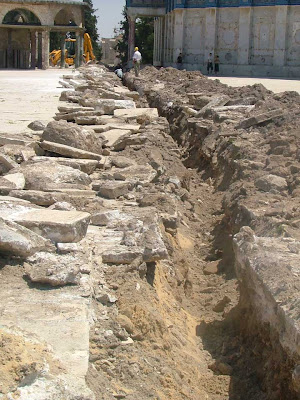
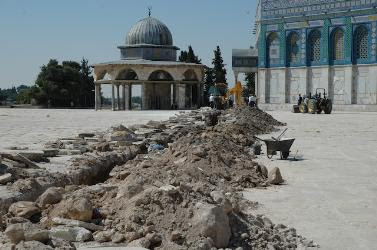
The following pictures of the ongoing construction were taken Tuesday:
Click here for more photos at the Temple Institute's web site. Extensive background information and up-to-date pictures can also be viewed at har-habayt.org
இப்போதும் அது இஸ்லாமியர்களின் கையிலேயே இருக்கிறது. வக்பு போர்டின் கட்டுப்பாட்டில் இருக்கும் இந்த மசூதியில் அகழ்வாராய்வாளர்கள் மேற்பார்வை இல்லாமல் கண்ட இடத்தில் தோண்டி புராதனமான புதையல்களை எல்லாம் குப்பைகளாக வீசிகொண்டிருக்கிறார்கள்.
Photos: Unsupervised Islamic Digging on Temple Mount
by Ezra HaLevi
(IsraelNN.com) The Islamic Wakf is digging large ditches on the Temple Mount without archaeological supervision to protect antiquities at Judaism’s holiest site.
Photos of the construction were publicized earlier this week. Investigation revealed that the dig had been approved by the police, though not coordinated with any archeological authorities. The ditch is being dug in the direction of the Dome of the Rock, the site of the Holy Temple, according to most opinions.
Police approval of the project, which involves heavy machinery, as well as a JCB tractor, was apparantly approved by the head of Israel’s Antiquity Authority. "The trench depth varies from 50 – 100 cm deep!" reports Zachi Zweig, an archaeologist that has been involved in exposing the Islamic Wakf's campaign of destroying Jewish artifacts on the mount. "Grey earth was removed from the dig, which indicates that it is archaeologically significant. In addition, signs of ancient architecture was exposed beneath the current platform slabs. It should be mentioned that the bedrock level at this location is very close to the current platform."
Zweig, who started the Temple Mound Debris-Sifting Project following his publicizing the dumbing of artifacts by the Wakf in the Kidron Valley, says the Antiquities Authority shares responsibility for the destruction. "It is an atrocity for which Antiquities Authority Director Shuka Dorfman, who authorized the dig, is responsible," Zweig said. "Ancient architectural remains were exposed during this dig in the northern section of the trench. No reasonable archaeologist would justify conducting a mechanical dig in such a sensitive location. The core problem here is that the IAA director is not an archaeologist, but rather a politician."
Past excavations carried out by the Wakf resulted in tons of priceless archaeological artifacts being mixed with garbage and dumped in the Kidron Valley. Some of that dumped earth was transported to the Tzurim Valley, below Hebrew University, where Zweig organized a group of archaeological students and volunteers who are still sifting through it after finding antiquities from the First and Second Temple periods.
Two archaeology students were detained by police Tuesday after asking workers questions about the dig. “The workers ignored us and called a Wakf official over. He complained to the police and upon our exiting the mount we were detained,” one of the students told Arutz-7.
Another group of archaeologists, the Committee for the Prevention of the Destruction of Temple Mount Antiquities, has protested the latest unsupervised construction by the Wakf, demanding that archaeologists be brought in to conduct the digging in a professional and documented manner.
Jerusalem-based architect Gideon Charlap took the following photographs atop the Temple Mount:
The following pictures of the ongoing construction were taken Tuesday:
Click here for more photos at the Temple Institute's web site. Extensive background information and up-to-date pictures can also be viewed at har-habayt.org
Subscribe to:
Posts (Atom)